
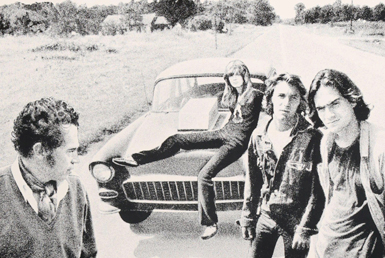

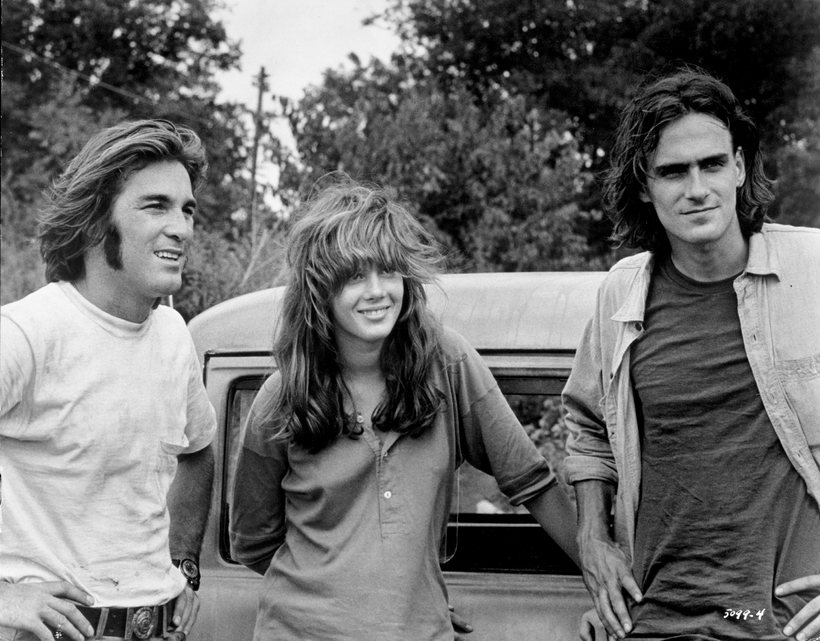
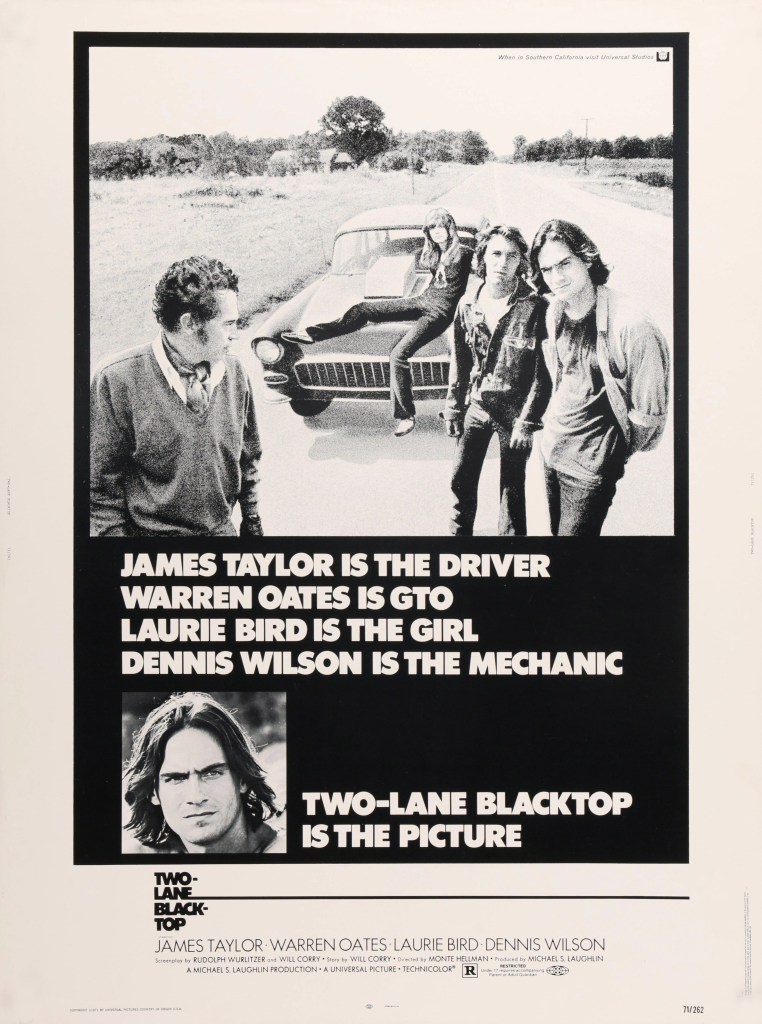
“Two-Lane Blacktop,” a 1971 road movie directed by Monte Hellman and written by Rudy Wurlitzer. The film follows two drag racers, referred to only as The Driver and The Mechanic (played by musicians James Taylor and Dennis Wilson), traveling across the country in a souped-up 1955 Chevy racing car, looking for competition and avoiding any kind of attachments or responsibilities.
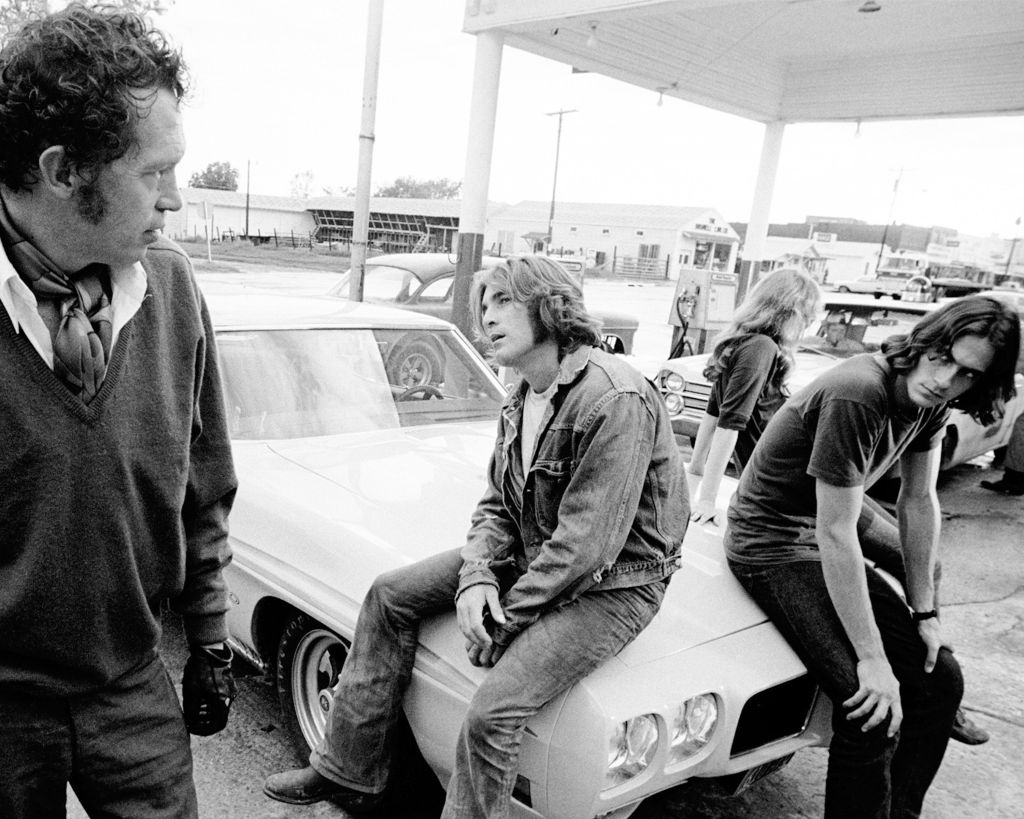
Along the way, they pick up a young hitchhiker, a girl called The Girl (played by Laurie Bird), who joins them on their journey. The trio travels from town to town, competing in street races against other drivers, and eventually, they meet up with G.T.O., a middle-aged man driving a 1970 Pontiac G.T.O. who challenges them to a cross-country race.
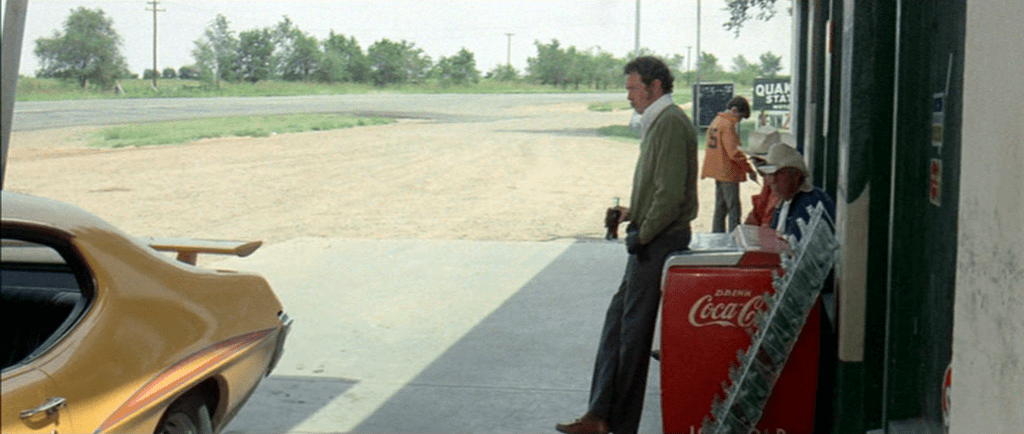
As the race progresses, the two groups compete against each other while also forming a bond of sorts, as The Girl becomes increasingly drawn to G.T.O. and The Driver and The Mechanic are forced to confront their own isolation and detachment.

The film’s sparse dialogue and minimal plot reflect its themes of existentialism and the search for meaning in a world that has lost its direction. The film’s characters are deliberately underdeveloped, making them more symbols than fully realized people, which allows the audience to project their own interpretations onto them.
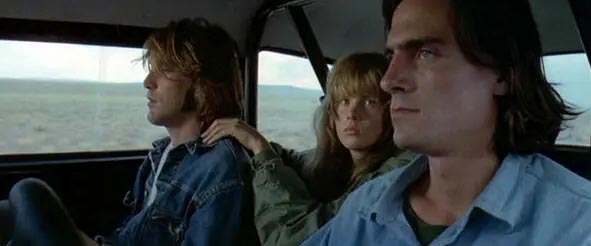
The film’s striking visuals, including long stretches of empty highways, gas stations, motels, and small towns, capture the essence of a desolate American landscape that is both beautiful and haunting. The film’s soundtrack, which includes classic rock and roll tunes, adds to the film’s sense of timelessness and wanderlust.
Despite its initial poor reception, “Two-Lane Blacktop” has since become a cult classic and is regarded as a landmark of American independent cinema, thanks to its minimalist style and commentary on the era’s counterculture.

Available via The Criterion Collection
 The Other Cinema